
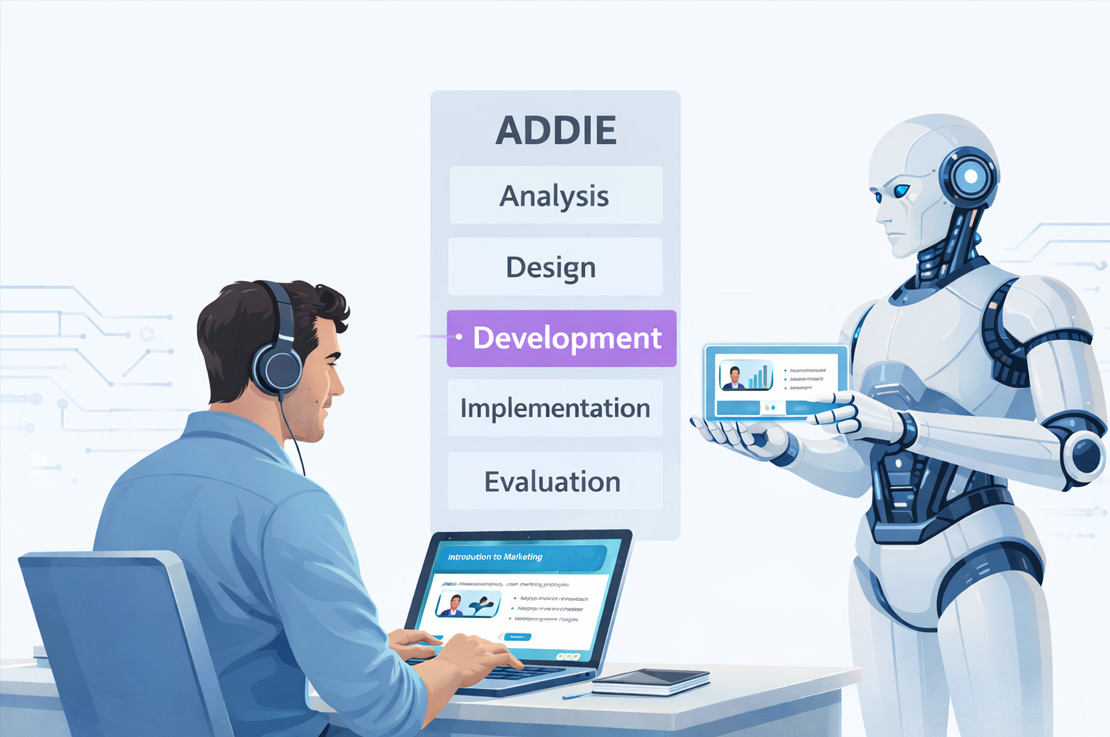
The conversation about AI in instructional design has gotten loud. LinkedIn is filled with posts about how AI is transforming the Analysis and Design phases of ADDIE. This widely used instructional design framework stands for Analysis, Design, Development, Implementation, and Evaluation.
AI is genuinely valuable in these early phases. It can analyze learner data to identify performance gaps, help structure learning objectives, and suggest instructional strategies. In this model, the instructional designer becomes a conductor, guiding decisions while AI serves as a powerful assistant. That’s not hype. That’s smart practice.
But scroll through these posts and you’ll notice something missing: the Development phase gets treated like an afterthought. Like AI just “handles it.” Like building the actual training is the easy part now.
That’s wrong.
The Misconception That’s Taking Hold
There’s a prevalent assumption spreading through L&D circles: since AI can generate content, storyboards, and interactive elements, the developer role has been minimized. Just prompt the AI, make a few tweaks, and ship it.
This thinking confuses speed with skill. It mistakes output for outcome.
AI can generate a course module in minutes. It can create quiz questions, draft scenarios, and produce voiceover narration. But it can’t understand the nuanced performance gaps in a pharmaceutical sales team rolling out a new oncology treatment. It can’t make strategic decisions about when a branching scenario serves learning better than a linear module. It can’t architect an experience that accounts for workflow integration and organizational change dynamics.
The development phase isn’t about transcribing content into a template. It never really was. Now it’s about mastering AI as a tool while maintaining strategic control over what gets built and how it serves the learner.
The Pilot and Co-pilot: Across the Entire Process
Think about commercial aviation. The co-pilot handles routine tasks, such as maintaining altitude following flight paths. But you’re not giving complete control to the co-pilot. The pilot stays hands-on with the controls. Making decisions. Monitoring conditions. Intervening when needed.
That’s the relationship between skilled L&D professionals and AI tools throughout the entire ADDIE process. In Analysis, AI surfaces patterns in learner data, but you’re validating those insights against organizational context that no algorithm understands. In Design, AI proposes instructional strategies, but you’re making the strategic call about what will work for your audience. In Implementation and Evaluation, AI tracks metrics and generates reports, but you’re interpreting what those numbers mean for real people and real business outcomes.
And in Development, where this becomes most visible, the professional remains the instructional and creative director. You’re steering. You’re deciding which scenarios get built and how they branch, where to invest in rich media vs. simpler interactions, where AI-generated content needs refinement for accuracy, and how to QA and validate that learning objectives are actually met.
AI is your partner throughout. A capable one. But it’s not flying the plane alone at any stage.
Two Opportunities, Not Just One
When L&D leaders talk about AI in development, they focus almost exclusively on efficiency. Faster turnaround. Lower costs. Do more with less. Those gains are real. That’s measurable ROI.
But there’s a second opportunity getting overlooked: AI lets you raise the bar.
Interactive simulations used to require weeks of development time and a budget that mid-range projects couldn’t justify. Now, AI-powered platforms let experienced developers create branching scenarios reflecting authentic workplace situations in a fraction of the time. AI-driven avatar and dialogue simulation tools enable dynamic role-play experiences where learners practice difficult conversations, from de-escalating an angry customer to managing a compliance discussion. Rich multimedia production that once required specialized vendors is now accessible to skilled developers working with AI tools.
The question isn’t just “Can we build this faster?” It’s “What can we build now that we couldn’t justify before?” An experienced developer who understands learning science and can harness AI strategically will create training that is more engaging, more interactive, and more effective than what was feasible two years ago.
The AI Slop Problem is Real
Not all AI-assisted development raises the bar. Much of it is producing what the industry now calls “AI slop.”
Research published in Harvard Business Review by BetterUp Labs and the Stanford Social Media Lab found that 40% of U.S. desk workers received AI-generated “workslop” in the past month. Each incident takes nearly two hours to resolve, translating to roughly $186 per employee monthly in extra costs. For a 10,000-person company, that’s an estimated $9 million a year in lost productivity. Low-quality AI-generated training isn’t just ineffective. It’s actively expensive.
Dr. Jill Stefaniak, Chief Learning Officer at Litmos and Associate Professor in the Learning, Design, and Technology program at the University of Georgia, has been clear: instructional design is and always will be a human-centered discipline. It requires empathy, a deep understanding of the learner, and strategic decision-making that AI cannot replicate. As she cautioned in a recent industry webinar, “I think we’re going to start hearing from our learners in this next little while, asking where’s the quality, and wanting that quality.”
AI slop in L&D looks like generic eLearning modules with no connection to your company’s culture. Poorly written job aids that confuse more than they help. One-size-fits-all training that fails to address specific learner needs. It’s bland, often useless, and produced in volume because it’s cheap and fast.
If you’re satisfied with checkbox compliance that technically covers the requirement but doesn’t change behavior, let AI run unchecked. Prompt it. Ship it. Move on. But your learners will disengage. They won’t retain. They won’t apply what they learned. And your business will pay for it in ways that never show up on the development invoice: failed compliance, lost productivity, and reputation damage.
Keep Your Hands on the Wheel
We’re at an inflection point. AI is democratizing content creation in ways that seemed impossible five years ago. That’s powerful. But power without skill produces garbage. In L&D, garbage in means garbage out.
The businesses that invest in AI-savvy developers who keep their hands firmly on the wheel will create a competitive advantage through talent development. They’ll onboard faster. They’ll scale training that actually drives performance. They’ll adapt quickly when conditions change.
The businesses chasing the cheapest, fastest path to “done” will discover that AI slop is expensive. Their learners and their businesses will pay the price.
AI is transforming every phase of ADDIE, including Development. That transformation is real and valuable. But it requires mastery. Strategic thinking. Human judgment. Quality control. The developers who learn to harness AI as a partner while maintaining their role as the one flying the plane will create training experiences that weren’t possible before.
The choice is yours.
What’s your experience with AI in the development phase? Are you seeing the bar raised, or are you drowning in AI slop?
References
Niederhoffer, K., Rosen Kellerman, G., Lee, A., Liebscher, A., Rapuano, K., & Hancock, J.T. (September 2025). “AI-Generated ‘Workslop’ Is Destroying Productivity.” Harvard Business Review. hbr.org
Stefaniak, J. (October 2025). “Avoid the AI Slop Trap: Using AI for Strategic Learning and Development.” Litmos Blog. litmos.com
Stefaniak, J. & Moore, S. (October 2025). “Keeping The Human Edge In AI-Assisted Instructional Design.” Webinar. eLearning Industry / Litmos. elearningindustry.com
Next Steps:
If you’re feeling the pressure to “do more with AI” but aren’t sure how to maintain the quality your learners need, let’s talk. We work alongside internal teams to develop training and help organizations figure out where AI fits and where it doesn’t.

Leave A Comment